

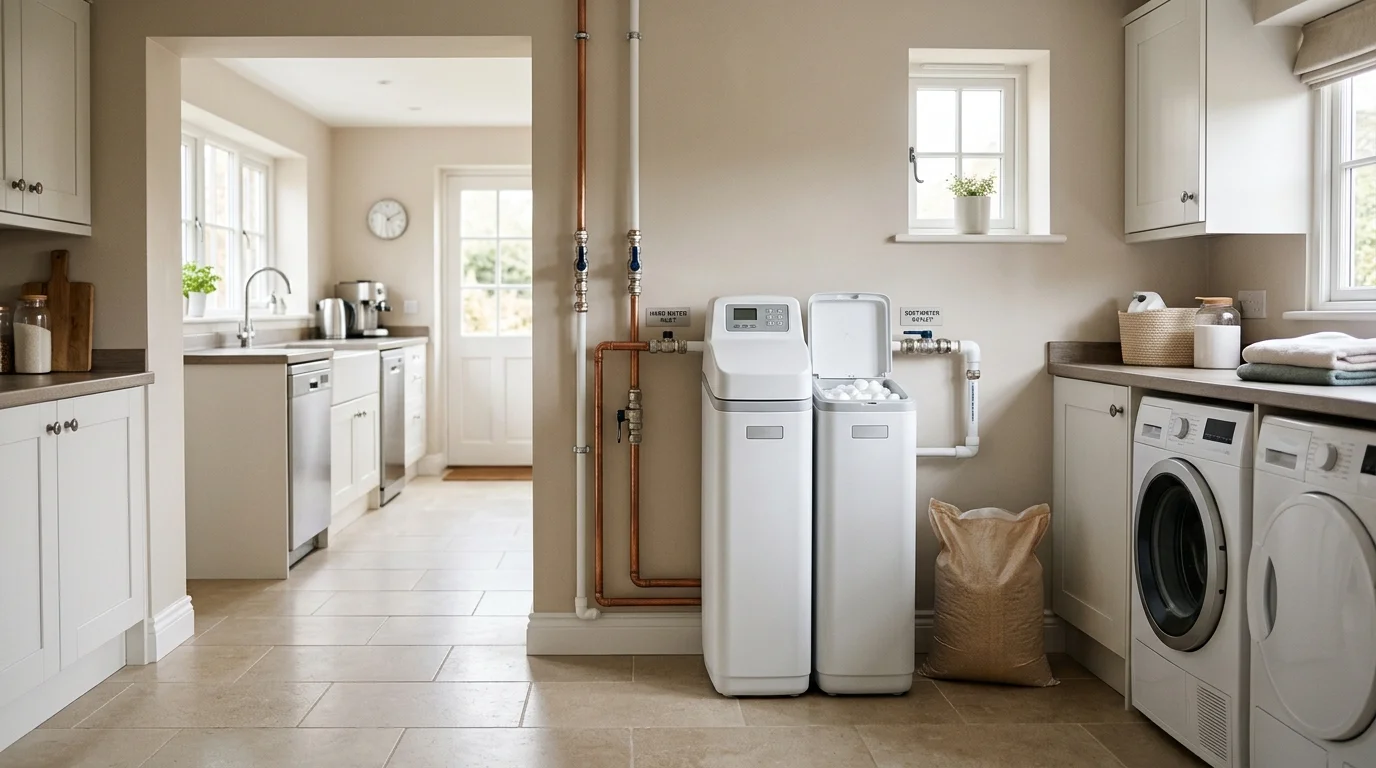
Hard water can leave limescale on taps, shower screens, kettles, boilers, and other household equipment. A water softener system tackles the minerals responsible instead of repeatedly cleaning the deposits they leave behind. For UK households in hard-water areas, that can reduce scaling and make everyday cleaning easier. Quick answer: A domestic softening unit usually removes calcium and magnesium through ion exchange. It can reduce limescale, improve soap lathering, and protect equipment exposed to heated water. UK buyers should compare water hardness, capacity, installation requirements, salt use, servicing, and drinking-water arrangements before choosing a model.
| What to check | Practical UK guidance |
|---|---|
| Main purpose | Reduce calcium and magnesium that cause hardness and limescale |
| Common technology | Salt-regenerated ion exchange |
| Typical equipment price | Around £500–£1,600 for current domestic models |
| Typical installation allowance | Around £350, depending on plumbing and location |
| Ongoing requirement | Salt, regeneration water, and periodic maintenance |
| Best suited to | Homes with persistent hard-water problems |
| Drinking-water consideration | Keep an appropriate unsoftened supply for drinking and cooking |
| Main buying factors | Capacity, flow rate, regeneration method, space, warranty, running costs |
Key Takeaways
* True softening removes hardness minerals rather than merely changing how scale behaves. * Hardness varies widely across the UK, so check your local reading before buying. * Salt-based units need periodic regeneration and regular salt replenishment. * Equipment prices commonly start near £500 and can exceed £1,500 before fitting. * Single-cylinder and twin-cylinder designs suit different budgets and usage patterns. * Drinking Water Inspectorate guidance supports retaining unsoftened water for drinking and cooking. * Correct sizing matters because household demand affects flow, salt consumption, and regeneration frequency.
How Does a Water Softener System Work?
Most domestic units use a process called ion exchange. Hard water passes through resin beads that attract dissolved calcium and magnesium. Sodium ions replace those hardness minerals before the treated water continues through the home. The resin eventually becomes loaded with calcium and magnesium. A concentrated salt solution then passes through the resin during regeneration. This process releases the captured minerals and prepares the resin for another cycle. Regeneration normally sends the removed minerals and used brine to a suitable drain. Modern units may trigger this cycle according to measured demand rather than a fixed timetable. The exact process varies between manufacturers and control systems. This process differs from physical or magnetic water conditioning. Those products may affect how scale forms, but they do not necessarily remove hardness minerals. The Drinking Water Inspectorate makes this distinction when discussing domestic treatment equipment.
How Hard Is Your Water?
Water hardness mainly comes from dissolved calcium and magnesium compounds. Its level depends heavily on the geology and water source serving your property. That explains why two UK regions can experience noticeably different scaling problems. The Drinking Water Inspectorate measures hardness using milligrams per litre as calcium carbonate. Its guidance classifies 200–300 mg/L as hard water. Readings above 300 mg/L fall into its very-hard category. Before spending money, check the hardness figure supplied by your water company. Many providers offer postcode-based information or publish local water-quality reports. A current reading gives an installer a better basis for sizing equipment correctly. Visible symptoms can support that information, although they do not replace a proper reading. Common signs include scale around taps and deposits inside frequently boiled kettles. Bathroom fittings may also need more frequent descaling in harder-water areas. Wrynia’s rimless toilet guide also explains how mineral deposits can collect around bathroom flush outlets. rimless toilet guide Hardness control can therefore influence cleaning needs across several household fixtures.
What Are the Main Benefits?
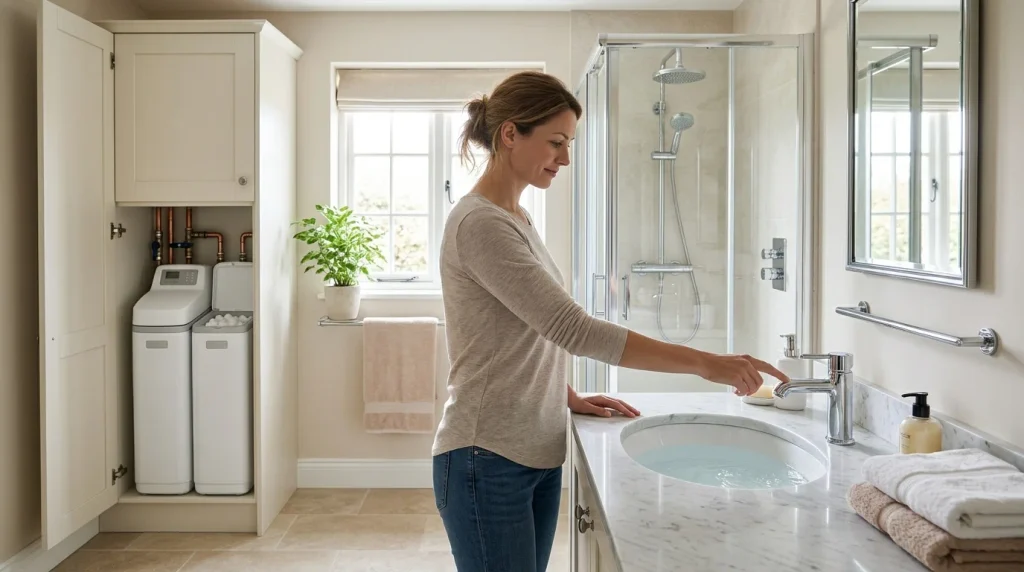
Reducing scale is usually the strongest reason to install a softener. Calcium deposits can develop where hard water is heated or allowed to evaporate. Removing much of the hardness reduces the material available to create those deposits. Less scale can also simplify cleaning around showers, basins, taps, and sanitary fittings. Soap generally lathers more easily in softened water. Households may therefore find they need less soap or detergent for certain tasks. Appliances exposed to heated water may benefit from reduced mineral accumulation. Kettles, washing machines, dishwashers, and hot-water equipment can all experience scale in hard-water areas. Actual savings depend on water hardness, equipment, usage, and maintenance. Bathroom surfaces still need normal cleaning after softening equipment is installed. Water marks, soap residue, and general dirt do not disappear automatically. The main difference is reducing persistent mineral deposits rather than eliminating household maintenance. If you are renovating at the same time, Wrynia’s bathroom tiles guide covers suitable materials and current UK cost considerations. bathroom tiles guide Planning plumbing changes before new finishes are installed can prevent unnecessary rework.
Types of Domestic Softening Equipment
Several products are marketed to homeowners experiencing scale, but they do not perform the same job. Understanding the treatment method matters more than relying on marketing terminology. Your choice should reflect hardness, water demand, available space, and maintenance preferences.
| Type | How it works | Main advantage | Main consideration |
|---|---|---|---|
| Single-cylinder ion exchange | One resin vessel softens water and later regenerates | Often compact and competitively priced | Softening may pause during regeneration |
| Twin-cylinder ion exchange | Two vessels alternate between treatment and regeneration | Continuous treated-water supply | Usually costs more |
| Electric metered model | Electronic controls monitor operation and regeneration | Flexible programming | Requires electricity |
| Non-electric model | Hydraulic controls operate from water flow | No electrical supply required | Product choices and controls vary |
| Physical conditioner | Changes scale behaviour without removing hardness | Low-maintenance option | Does not produce genuinely softened water |
A single-cylinder model may suit a smaller household with predictable demand. Twin-cylinder equipment can maintain supply while one vessel regenerates. That feature may matter in larger homes with simultaneous showers or appliance use. Electricity is another point worth checking before purchase. Some designs use electronic timers or meters, while others operate without mains electricity. Neither design is automatically correct for every property. Do not confuse filters with softeners either. A drinking-water filter may target tastes, particles, chlorine, or particular contaminants. Softening equipment primarily addresses hardness minerals and the scale they create.
How Much Does a Softener Cost in the UK?
Current UK pricing varies substantially between simple domestic units and premium twin-cylinder products. Checkatrade’s 2026 guide places budget equipment at around £500. Its figures reach roughly £1,600 for higher-priced twin-cylinder models. That guide also gives around £350 as a typical installation allowance. Your final bill can differ because pipework, drainage, valves, cabinet space, and access affect labour. Always compare complete fitted quotations rather than equipment prices alone. Running costs mainly involve salt and regeneration water. Some electric models also use a small amount of electricity. Servicing costs depend on the product, warranty conditions, installer, and maintenance agreement. Manufacturer figures can help with comparisons, but treat them as product-specific examples. Kinetico currently gives an estimated monthly salt cost for a family of four using certain models. Your household may use a different amount because hardness and water consumption vary.
What Should You Check Before Installation?
Start with the incoming mains position and available space. Installers commonly position domestic equipment near the incoming supply, subject to the property’s plumbing layout. The unit also needs suitable drainage for regeneration. Flow rate deserves attention in busy households. A unit that is undersized for peak demand may affect the experience when several outlets run together. Ask the supplier to size the equipment using occupancy, bathrooms, hardness, and expected usage. Check whether outdoor taps need treated water. Using softened supplies for garden watering can consume salt without providing much practical benefit. Your installer can advise whether selected outlets should bypass the unit. The installation should also allow safe servicing and salt replenishment. A cabinet may technically fit while leaving poor access for routine maintenance. Check dimensions with the lid, connections, and service clearance included. UK buyers should use equipment suitable for domestic water systems and applicable fittings requirements. The Drinking Water Inspectorate recommends reputable suppliers and suitably qualified installers. It also advises checking relevant requirements with your water company where necessary.
Can You Drink Softened Water?
This point needs careful attention with traditional ion-exchange equipment. The process replaces calcium and magnesium with sodium. Sodium levels can therefore increase after treatment. The Drinking Water Inspectorate advises retaining an unsoftened supply for drinking and cooking. It warns that softening can sometimes increase sodium enough to affect compliance. This advice is especially relevant for people following low-sodium diets. Artificially softened water should not be used to prepare infant formula. The kitchen drinking tap should therefore be considered during installation planning. Discuss the arrangement with a qualified installer before modifying the incoming supply. The exact plumbing solution depends on the property and equipment. Some homes retain a separate unsoftened kitchen tap. Others may use a carefully planned arrangement that keeps drinking supplies outside the treatment route.
Maintenance and Salt Use
Salt-regenerated units cannot keep working indefinitely without replenishment. Salt creates the brine used to recharge the resin during regeneration. The frequency of refilling depends on household demand, hardness, and equipment efficiency. Check the salt level regularly according to the manufacturer’s instructions. Do not assume every unit uses the same block, tablet, or granular product. Using the specified salt helps the regeneration system operate as designed. Periodic servicing can also identify valve, drainage, or calibration problems. The Drinking Water Inspectorate advises following manufacturer maintenance instructions for domestic treatment equipment. Poorly maintained equipment can create hygiene or performance problems. If nearby wet-area seals need attention, choose products designed for continuous moisture exposure. Wrynia’s decorators caulk guide explains why ordinary paintable filler is unsuitable around repeatedly wet sanitary joints. decorators caulk guide Matching materials to their actual conditions prevents avoidable maintenance later.
Is a Water Softener Worth It?
The answer depends mainly on local hardness and how much scale affects your home. A softener becomes easier to justify when deposits repeatedly affect bathrooms, kettles, appliances, and hot-water equipment. Households in softer-water regions may see little benefit from the same investment. Consider your current spending on descaling products and repeated cleaning. Then compare those costs with purchase, installation, salt, water, and servicing. This provides a more useful decision than focusing on the purchase price alone. Comfort and convenience matter too. Easier lathering and less stubborn scale can improve daily routines. These benefits are personal, so they are harder to value in pounds. A sensible decision starts with a verified hardness reading and a properly sized quotation. Ask how much salt and regeneration water the proposed unit uses. Also confirm warranty terms, servicing requirements, flow capacity, and drinking-water arrangements.
Common Buying Mistakes to Avoid
Many purchasing problems come from choosing equipment before checking the property. A cheap unit can become expensive if major plumbing alterations are required. Measuring available space and locating drainage early reduces that risk. Another mistake is assuming every anti-scale device genuinely softens water. Magnetic and electronic conditioners work differently from ion-exchange equipment. Ask the supplier whether its product physically removes calcium and magnesium. Do not compare models using purchase price alone. Flow capacity, salt consumption, regeneration water, warranty terms, servicing, and installation all affect ownership costs. A complete quotation makes those differences easier to judge. Finally, avoid treating softer water as a substitute for normal household maintenance. Bathrooms, appliances, and pipework still need appropriate care. Softening mainly reduces hardness-related scale rather than solving every water or plumbing problem.
Frequently Asked Questions
What does a water softener system do?
A water softener system reduces calcium and magnesium that cause hard water. Most domestic models achieve this using sodium-based ion exchange. Reducing these minerals limits the amount of limescale that can form.
How do I know whether my home has hard water?
Check the hardness information supplied by your water company. Postcode tools and water-quality reports often provide a local figure. Visible kettle scale and deposits around taps can provide additional clues.
How much does a domestic softener cost?
Current UK equipment prices can range from roughly £500 to around £1,600. Professional installation may add several hundred pounds depending on the property. Salt, regeneration water, and possible servicing also contribute to ownership costs.
Does a softener remove limescale already inside pipes?
Its main function is preventing new hardness minerals from entering treated plumbing. Existing deposits will not necessarily disappear immediately after installation. Severe scale may still require inspection, cleaning, or other remedial work.
Do all softeners need salt?
Traditional ion-exchange units normally require salt for regeneration. Products advertised as salt-free conditioners use different treatment methods. They should not automatically be considered equivalent to true softening.
Where is the equipment normally installed?
Domestic units are often fitted near the incoming mains supply. They also need appropriate access to drainage and enough room for servicing. The correct position depends on your plumbing layout and chosen model.
Choosing the Right Setup for Your Home
Start by checking your actual hardness figure rather than buying from visible scale alone. Then compare systems sized for your household, bathrooms, peak flow, and available installation space. This approach reduces the risk of paying for unnecessary capacity. Ask every supplier for a complete installed price and clear running-cost information. Confirm salt requirements, regeneration water, warranty coverage, servicing, and the arrangement for drinking water. Those details reveal more than headline equipment prices. For a hard-water home, correctly chosen softening equipment can reduce persistent scale and simplify routine cleaning. It can also protect surfaces and equipment exposed to heated water. Get a qualified installation quotation based on your property’s measured hardness and plumbing before making the final choice. —