

Finding the right dehumidifier in the UK is less about buying the biggest litre rating and more about matching the machine to your home, room temperature, and moisture problem. A unit that performs well in a heated bedroom may be less suitable for a cold garage, while a tiny low-power model can struggle with regular family laundry or persistent condensation.
This guide explains what capacity actually means, the difference between compressor and desiccant models, current running costs, and the features worth paying for. It also shows where a dehumidifier can help and where ventilation, repairs, or proper damp treatment should come first.
Quick answer: A dehumidifier is worth considering in a UK home when humidity stays high, windows regularly collect condensation, laundry dries slowly, or rooms smell musty. For most heated homes, a 12–20 L compressor model with a humidistat and laundry mode offers a practical balance of extraction, noise, and electricity use.
| What to check | Practical starting point |
| Most heated bedrooms/flats | 10–12L compressor |
| Larger rooms or regular laundry | 16–20 L compressor |
| Cold garage, cellar, or unheated space | Desiccant model |
| Useful humidity range | Around 40–60% RH |
| Important features | Humidistat, laundry mode, auto shut-off |
| Convenient extras | Continuous drainage, timer, wheels, app control |
| Current GB electricity reference | 26.11p/kWh until 30 September 2026 |
| Biggest buying mistake | Choosing only by the headline litres-per-day figure |
Is a Dehumidifier Worth It in a UK Home?
A dehumidifier in the UK can be particularly useful where everyday activities such as showering, cooking, and drying washing create more moisture than ventilation can remove. Energy Saving Trust says signs of excess moisture can include heavy window condensation, black mold, and musty smells, and it specifically identifies dehumidifiers as one option for excessive moisture or indoor laundry. The UK’s cool and wet climate can contribute to condensation, although the condition of the building and the way rooms are ventilated matter just as much.
The important limitation is that a UK dehumidifier only removes moisture already present in the air. It does not bring fresh outdoor air into the building, so Energy Saving Trust advises maintaining suitable ventilation even when one is running. It also cannot repair a leaking roof, damaged gutter, leaking pipe, or failed damp-proof course, which means persistent damp patches need their underlying cause investigated rather than simply being dried repeatedly.
1. Choose Between Compressor and Desiccant Technology
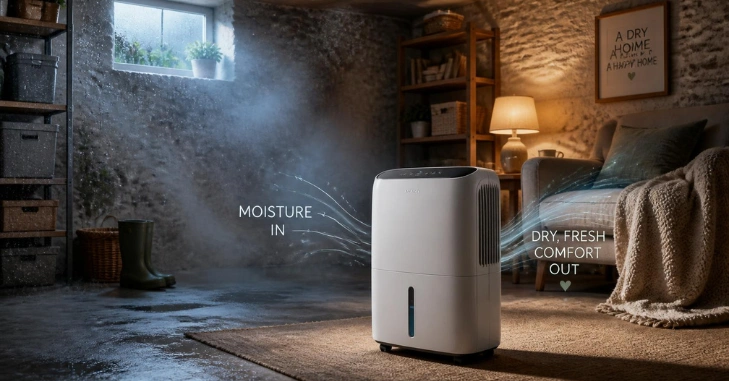
The first decision should usually be the type of dehumidifier rather than the brand. Compressor and desiccant machines remove moisture in different ways, and room temperature has a major effect on which design makes sense. Compact thermoelectric or Peltier units form a third category, but they generally suit very small spaces and light moisture rather than a genuinely damp room.
| Type | Best suited to | Main advantage | Main trade-off |
| Compressor | Heated bedrooms, living rooms, flats, and houses | Lower power demand in normal room conditions | Extraction falls as rooms become colder. |
| Desiccant | Garages, cellars, caravans, and cold rooms | Stronger low-temperature performance | Higher electricity consumption |
| Mini/Peltier | Wardrobes and very small spaces | Compact and quiet | Much lower extraction capacity |
Compressor Dehumidifier in the UK
A compressor model is the logical starting point for most normally heated UK homes. It cools part of its internal system so water vapor condenses and drains into a tank, and current domestic models commonly combine this with a humidistat that switches extraction on and off according to room conditions.
Current examples show why these machines are attractive for daily home use. The Meaco Arete Two 20L uses 207W at 20°C and 60% RH. The Pro Breeze OmniDry 12L is rated at 0.18 kWh of energy consumption, and the brand’s standard 12L humidistat model is at 0.2 kWh.
Desiccant Dehumidifiers
A desiccant unit becomes more compelling when the room is genuinely cold for long periods. Instead of relying on the same condensation process as a compressor unit, it uses moisture-absorbing material and is therefore well suited to spaces such as garages, boats, cellars, and unheated utility areas.
EcoAir’s DD1 Simple MK3, for example, is specified for operation from 1°C to 35°C and removes 7.5 liters per day at 20°C and 60% RH. Its power consumption is substantially higher, though, at 300W in low mode and 580W in high mode.
Mini and Peltier Models
Small thermoelectric dehumidifiers can look attractive because they are cheap, compact, and consume little electricity per hour. Their extraction capability is also far below that of full compressor or desiccant machines, so they are better viewed as local moisture-control devices for cupboards, wardrobes, and other small spaces rather than substitutes for a 12 L or 20 L room dehumidifier.
Buying an undersized machine simply because its hourly electricity figure looks low can be a false economy if it has to run constantly without bringing humidity under control.
2. Understand What “12L” or “20L per Day” Really Means
The liters-per-day number is an extraction rating rather than the size of the water tank. It represents how much water a machine can remove under specified test conditions, and those conditions can be much warmer and more humid than the average British bedroom in winter. You should therefore compare the headline capacity with the manufacturer’s extraction data at realistic temperatures whenever that information is available.
The Meaco Arete Two 20L shows the difference clearly. Although it is classed as a 20L model, Meaco states an extraction rate of 8.5 litres per day at 20°C and 60% RH, rising to 13.85 litres at 20°C and 80% RH and 20.45 litres at 30°C and 80% RH. The lesson is not that its headline specification is misleading, but that temperature and relative humidity strongly affect how much water any compressor-based machine can actually collect in your home.
A practical capacity shortlist looks like this:
| Capacity | Sensible starting use |
| Mini/sub-5L class | Wardrobe, cupboard, or very light local moisture |
| Around 10–12L/day | Bedroom, small flat, or moderate condensation |
| Around 16–20L/day | Larger living areas, several rooms, or frequent laundry |
| 25–30 L+ | Large open-plan areas or heavier moisture loads |
| Desiccant 7–10 L/day | Cold spaces where compressor performance would fall |
These are buying tiers rather than universal room-size guarantees. Manufacturers test and describe room coverage differently, while ceiling height, temperature, doors, insulation, moisture production, and the severity of the problem all change real-world performance.
If you are regularly drying several washing-machine loads indoors or trying to manage moisture across multiple rooms, moving up one capacity tier can be more useful than buying the smallest machine that technically covers the floor area.
3. Compare Strong Current Models by Use Case
There is no single model that is automatically best for every household. Expert reviews named the Meaco Arete Two its 2026 Dehumidifier of the Year and recorded strong humidity reduction. The Independent selected the Duux Bora Smart 30L as its overall favorite in its July 2026 testing. Those different results illustrate how test conditions and priorities can produce different winners. The table below therefore treats current machines as useful reference points rather than claiming Wrynia has performed its own hands-on laboratory testing.
| Model | Good fit for | Capacity | Noise | Tank | Rated/input power | Approx. cost/hour* |
| MeacoDry Arete Two 20L | Premium all-round use, larger homes | 20L | 38–50dB | 4.8L | 207W at 20°C/60% RH | ~5.4p |
| Pro Breeze OmniDry 20L | Value, laundry, and smart controls | 20L | 36dB | 4L | 270W | ~7.0p |
| Duux Bora Smart 20L | Smart control and larger rooms | 20L | 36–42dB | 4L | Up to 260W | Up to ~6.8p |
| Pro Breeze 12L Humidistat | Bedrooms and smaller rooms | 12L | 38dB | 1.8L | 200W | ~5.2p |
| EcoAir DD1 Simple MK3 | Cold and unheated spaces | 7.5L | 34–47dB | 2L | 300–580W | ~7.8–15.1p |
*Approximate costs use Ofgem’s current 26.11p/kWh GB Direct Debit electricity reference for 1 July to 30 September 2026. Actual consumption changes with operating mode, humidity, temperature, and compressor cycling, while your tariff can differ from the cap reference rate. Manufacturer specifications and current prices/features were checked directly with Meaco, Pro Breeze, Duux, and EcoAir in September 2026.
At the time of research, Meaco listed the Arete Two 20L at £299.99, EcoAir listed the DD1 Simple MK3 at £199.98, and Duux had the Bora Smart 20L on sale at £239.99. Pro Breeze pricing was particularly promotion-sensitive, with its 20L OmniDry appearing around the £170–£220 range across current manufacturer listings and the standard 12L humidistat model around £140. Treat those figures as shopping reference points rather than fixed prices because promotions and stock can change quickly.
4. Calculate the Real Running Cost Before Buying
Hourly running cost is simple to estimate when you know the appliance’s input power. Divide watts by 1,000 to convert them to kilowatts, then multiply by the price you pay for one kilowatt-hour of electricity. Ofgem’s average electricity unit rate for a standard-variable-tariff customer paying by Direct Debit in England, Scotland, and Wales is 26.11p/kWh from 1 July to 30 September 2026, while the announced reference becomes 26.32p/kWh for 1 October to 31 December.
| Rated input | Approx. hourly cost at 26.11p/kWh | 8 hours at full rated input |
| 180W | 4.7p | 38p |
| 200W | 5.2p | 42p |
| 250W | 6.5p | 52p |
| 300W | 7.8p | 63p |
| 500W | 13.1p | £1.04 |
| 580W | 15.1p | £1.21 |
These calculations assume continuous operation at the stated power, so they should not be treated as a prediction of your exact bill. A humidistat-equipped compressor can cycle the compressor off after reaching its target, which can reduce actual consumption, while laundry modes are deliberately designed to work harder for longer. For meaningful comparisons, look at watts, your own tariff, and the likely hours of use instead of relying only on a retailer’s “costs from X pence per hour” headline.
5. Prioritise a Humidistat, Not Just Extraction Power
A built-in humidistat lets the appliance respond to relative humidity instead of running blindly for a fixed number of hours. UK housing guidance commonly places a healthy indoor relative-humidity range at roughly 40–60%, while research published on GOV.UK notes that Approved Document F uses a 65% 30-day moving-mean limit when considering condensation and mold risk. A practical starting point for many homes is therefore around 50–55%, then adjusting according to condensation, temperature, and comfort rather than trying to make the air as dry as possible.
A cheap digital hygrometer is useful even when the dehumidifier includes its own sensor. Place it away from the machine’s direct outlet so you can see how the wider room behaves, then monitor readings at different times of day for several days. Short humidity spikes after a shower or cooking are different from a bedroom or living room that remains above 60–65% for hours.
6. Choose Laundry Mode If You Regularly Dry Clothes Indoors
Laundry is one of the strongest reasons to buy a full-size dehumidifier in the UK. As moisture evaporates from wet clothes, it enters the surrounding air, and removing that moisture helps the drying process continue while limiting how much water remains in the room. Energy Saving Trust specifically suggests considering a dehumidifier when drying washing indoors, although reducing moisture production and maintaining suitable ventilation are still important.
For better results, use the washing machine’s fastest suitable spin cycle before hanging the load, spread the garments so air can circulate and place the rack in a reasonably small room. Close external windows while the dehumidifier is actively drying the washing, follow the appliance instructions for clearance around its intake and outlet, and use laundry mode if the manufacturer provides one. If you are deciding between appliances, Wrynia’s Heated Clothes Airer Buying Guide explains how heated racks compare for capacity, electricity use, and indoor drying.
Using a dehumidifier with a heater can also make sense when you want both faster evaporation and active moisture removal. Wrynia’s current heated-airer research notes that the two products solve different parts of the same problem: the airer supplies targeted warmth while the dehumidifier removes water from the room air. The combination costs more than operating either appliance alone, so it is most useful when fast indoor laundry drying is a regular need rather than an occasional inconvenience.
7. Check Noise, Tank Size, and Drainage Before Paying for Smart Features
Noise matters most in bedrooms, home offices, and smaller flats where the appliance will be close to you for hours. Current domestic examples range from around the mid-30s dB on quieter settings to the high-40s or 50 dB at stronger fan speeds, so compare figures for the mode you will actually use rather than the lowest number printed in an advert. The Meaco Arete Two, for instance, is rated at 38, 40, and 50 dB across its fan settings, while Pro Breeze lists the OmniDry 20 L at 36 dB and EcoAir states 34/47 dB for its DD1 Simple MK3.
Tank capacity matters for convenience rather than extraction power. A 20L-per-day machine does not need a 20L water tank, but a larger reservoir means less frequent emptying when humidity is high, and continuous drainage can be valuable where a suitable drain is available. Timers, child locks, castors, washable filters, and easy-to-clean tanks generally affect everyday use more than app control, so treat Wi-Fi as a bonus after capacity, noise, and drainage have been checked.
Where Should You Put a Dehumidifier?
For one damp room, position the machine where air can move freely around the intake and outlet and follow the clearance distances in the manufacturer’s manual. Do not push it tightly against furniture, curtains, or a wall simply to hide it, because restricting airflow can reduce performance. If you are trying to influence several rooms, a more central position with internal doors open can help, whereas a laundry session generally works better when the washing and machine are contained in one room.
Bathrooms need additional care because water and mains electricity are a hazardous combination. Do not assume that an ordinary portable dehumidifier is designed to sit beside a bath or shower, and never place a unit where it may be splashed unless the manufacturer specifically approves that installation. One practical approach is to use the bathroom extractor during and after a shower, then tackle remaining moisture from a safe position outside the wet area according to the appliance instructions.
Can a Dehumidifier Stop Damp and Mould?
Lowering excess indoor humidity can make conditions less favorable for condensation-related mold, but a dehumidifier is not a universal damp cure. Energy Saving Trust distinguishes condensation from rising damp and penetrating damp, noting that leaks, roofing faults, gutters, and failed damp-proof protection may require repair or professional investigation. If a wet patch becomes worse after rain, appears persistently at the bottom of a wall or follows a leaking pipe, drying the air alone is unlikely to solve the underlying defect. Mould also deserves attention because it is more than a cosmetic problem.
Common Dehumidifier Buying Mistakes
- Buying the smallest model because it is cheapest: A low-capacity unit may run continuously without dealing with a large moisture load.
- Treating liters per day as tank capacity: Extraction rating and water-tank volume are two separate specifications.
- Ignoring room temperature: A compressor unit that is ideal in a warm lounge may not be the best choice for a cold garage.
- Focusing only on purchase price: Compare wattage, runtime, filters, warranty, and drainage as well as the upfront cost.
- Expecting it to repair damp: Penetrating damp, leaks, and rising damp need their actual causes corrected.
- Blocking airflow: Leave the clearance specified by the manufacturer around air intakes and outlets.
- Buying smart features before practical ones: A good humidistat, suitable capacity, and manageable noise matter more than an app.
Dehumidifier vs. Portable Air Conditioner
A portable air conditioner and a dehumidifier can both remove some moisture, but their main purposes are different. A dehumidifier is designed primarily to control humidity, while a refrigeration-based portable AC is designed to lower room temperature and normally needs an exhaust hose through a window. If summer cooling is your main problem rather than winter condensation, Wrynia’s portable air conditioner guide for UK homes explains room sizing, window kits, noise, and running costs in more detail.
The electricity difference can also be significant. Wrynia’s current portable-AC comparison uses examples from about 800W to 1,400W, whereas many mainstream compressor dehumidifiers in this guide are around 180W to 270W during active extraction. That does not make the two appliances directly interchangeable, because the air conditioner is doing the energy-intensive job of removing heat from the room as well as managing some moisture.
The Verdict: Which Dehumidifier Should You Buy in the UK?
For most heated UK bedrooms, flats, and everyday living spaces, start with a 10–12 L compressor model if the moisture problem is moderate and move towards 16–20 L when you have larger rooms, persistent condensation, or regular indoor laundry.
Choose a desiccant model instead when the appliance will spend much of its time in a genuinely cold garage, cellar, caravan, or similar unheated space. Whichever type you buy, prioritize a reliable humidistat, realistic noise level, sensible tank or drainage arrangement and known power consumption before paying extra for Wi-Fi or other convenience features.
A dehumidifier should also fit into a wider moisture-control strategy rather than replacing it. Keep extractor fans and trickle vents working, ventilate appropriately, avoid allowing indoor laundry moisture to spread unchecked and investigate leaks or persistent damp patches rather than repeatedly drying around them. For related practical household advice, Wrynia’s Home Improvement guides cover other appliances, renovations, and everyday ways to make UK homes more comfortable and efficient.
Conclusion
Choosing the right dehumidifier in the UK model is ultimately about matching the appliance to your home, room temperature, humidity levels, and the type of moisture problem you are trying to control. For most heated bedrooms, flats, and living spaces, a 10–12 L compressor dehumidifier can be a sensible starting point for moderate condensation, while larger 16–20 L models provide greater extraction capacity for bigger rooms, persistent humidity, and regular indoor laundry. For genuinely cold areas such as garages, cellars, caravans, and unheated utility spaces, a desiccant dehumidifier may perform more reliably because compressor extraction can fall as temperatures drop.
The headline litres-per-day figure should not be the only factor influencing your decision. Real-world extraction depends heavily on temperature and relative humidity, so checking manufacturer performance data under realistic conditions can give you a much better idea of what to expect
FAQs
What size dehumidifier is best for a UK bedroom?
A 10–12L compressor model is a sensible starting point for many heated bedrooms with moderate condensation, although room size and moisture levels still matter. Noise deserves particular attention if you plan to use it while sleeping, with quieter current models operating around the mid-30s dB on their lowest settings. If the bedroom is unusually large, persistently wet, or connected to several other spaces, stepping up in capacity may reduce the time needed to reach the target humidity.
Is a 12L or 20L dehumidifier better?
A 12L model is usually easier to justify for a smaller room, flat or moderate condensation problem, while a 20L machine provides more extraction headroom for larger homes and regular laundry. The 20L rating does not mean it will collect 20 liters every day in normal British winter conditions, because extraction varies with temperature and humidity. Compare realistic extraction data, wattage, noise, and tank size before assuming that bigger is automatically better.
How much does a dehumidifier cost to run in the UK?
At Ofgem’s 26.11p/kWh electricity reference for 1 July to 30 September 2026, a 200W machine costs about 5.2p for an hour at its full stated input. A 300W appliance works out at roughly 7.8p per hour, while a 580W desiccant unit would be around 15.1p at that power level. Real bills can differ because of your tariff, the selected mode, and the way humidistat-controlled machines cycle during use.
What humidity should I set my dehumidifier to?
Around 50–55% RH is a practical starting point for many UK homes because it sits comfortably within the widely cited 40–60% indoor range. You may need to adjust the setting if cold surfaces are still collecting condensation, and brief humidity spikes after bathing or cooking are less important than persistently high readings. Avoid trying to remove as much moisture as possible simply because the appliance allows a much lower setting.
Will a dehumidifier get rid of black mold?
A dehumidifier can lower humidity and help reduce the conditions that allow condensation-related mold to return, but it does not remove established mold by itself. Existing mould should be dealt with appropriately, while leaks, penetrating damp, rising damp, or defective ventilation need their underlying causes addressed. Treat the machine as moisture-control equipment rather than as a substitute for cleaning, repairs, or professional remediation.
Is a dehumidifier good for drying clothes indoors?
Yes, a suitable dehumidifier can help because it removes water released into the air as wet clothes dry. A dedicated laundry mode usually keeps the machine working more aggressively for a defined period, while a fast washing-machine spin and good spacing between garments can improve the overall drying setup. It also stops laundry moisture lingering in the room, which is particularly useful during wet UK weather when outside drying is impractical.
Should windows be open when a dehumidifier is running?
During a focused dehumidifying or laundry session, leaving external windows wide open can make the appliance continually process incoming outdoor air instead of concentrating on the room. That does not mean ventilation should be abandoned, because fresh-air ventilation remains important for indoor air quality and moisture management.