
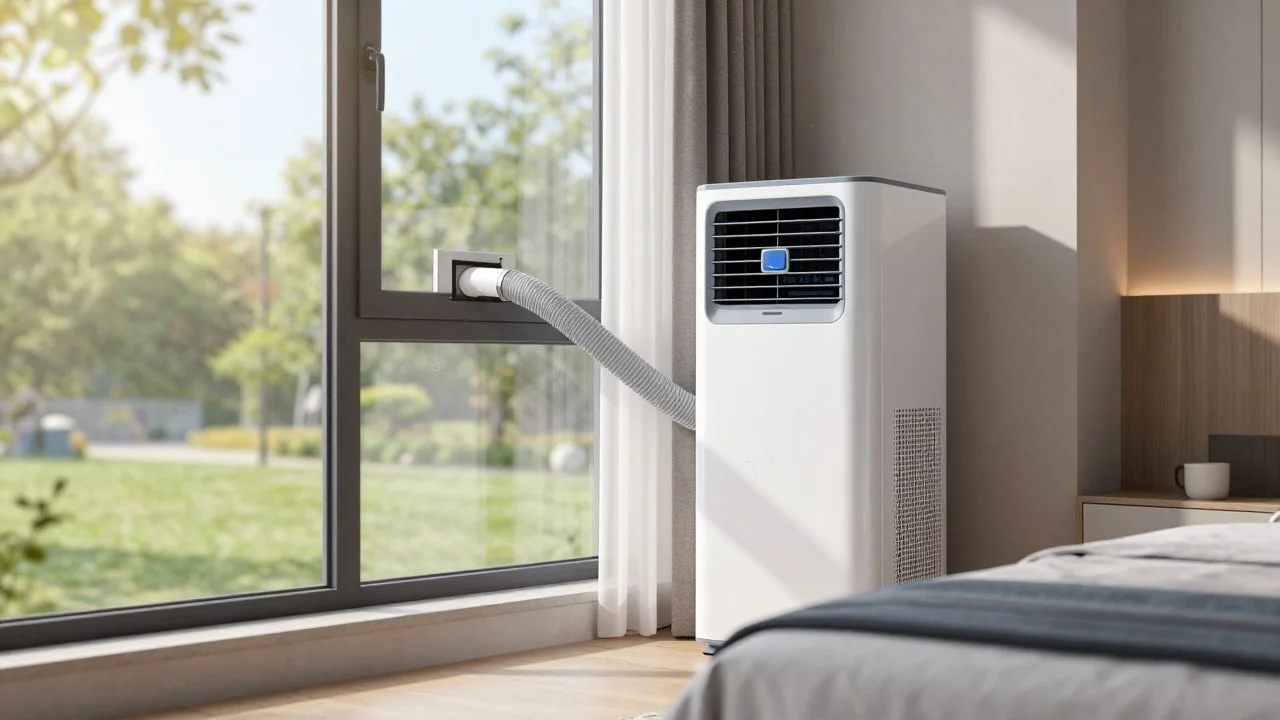
A portable air conditioner can make a bedroom, home office, or living room far more comfortable during hot weather. The challenge is choosing enough cooling power without buying a bulky unit that costs more to run than necessary. Current UK options range from value models below £300 to premium units costing more than £700. More from us: Rotavator.
For most UK homes, the right portable AC is the smallest properly sized model that can cool the room without running flat out. Match the BTU rating to the room size, make sure the exhaust hose can be sealed to your window, then compare noise levels, wattage, controls, and warranty coverage before buying. For a closer look at this, see Handheld Fan Buying Guide for UK Summers.
| What to check | Practical starting point |
|---|---|
| Small rooms | Around 5,000 to 7,000 BTU |
| Medium rooms | Around 9,000 BTU |
| Larger rooms | Around 12,000 BTU or more |
| Window requirement | Exhaust hose plus a suitable window seal |
| Running cost | Calculate from the unit’s input wattage |
| Bedroom use | Compare measured noise, not marketing terms |
| Useful extras | Timer, sleep mode, dehumidifying mode, and washable filter |
Room-size claims vary between manufacturers. A 5,000 BTU Pro Breeze model is rated for rooms of up to 12 m², while Meaco rates one 9,000 BTU model for spaces of 16 to 26 m². Its 12,000 BTU Cirro model is designed for spaces of around 20 to 30 m².
How to Choose a Portable Air Conditioner for Your Room
BTU measures cooling capacity. A higher BTU rating normally means more cooling power, but bigger isn’t automatically better. A unit that is too small may struggle to cool the room for long periods. One that is oversized can cost more, take up more floor space, and add unnecessary noise.
Use the manufacturer’s room-size rating as your first filter. Then consider ceiling height, insulation, direct sunlight, windows, electrical equipment, and the number of people using the space. These factors can all affect real-world cooling performance.
| Cooling tier | Likely use | Advantages | Trade-offs |
|---|---|---|---|
| 5,000 to 7,000 BTU | Small bedrooms and compact offices | Smaller body, lower power demand, easier storage | May struggle in sunny or larger rooms |
| Around 9,000 BTU | Typical bedrooms and home offices | Good balance of size and cooling power | Heavier and usually more expensive |
| 12,000 BTU+ | Living rooms and hotter spaces | More cooling capacity and faster temperature reduction | Higher purchase cost, weight, and energy use |
These ranges are guides, not universal rules. Independent tests and manufacturer ratings can give different room-size figures for units with similar BTU ratings. Check the specifications for the exact model you plan to buy.
The Window Kit Can Make or Break the Setup
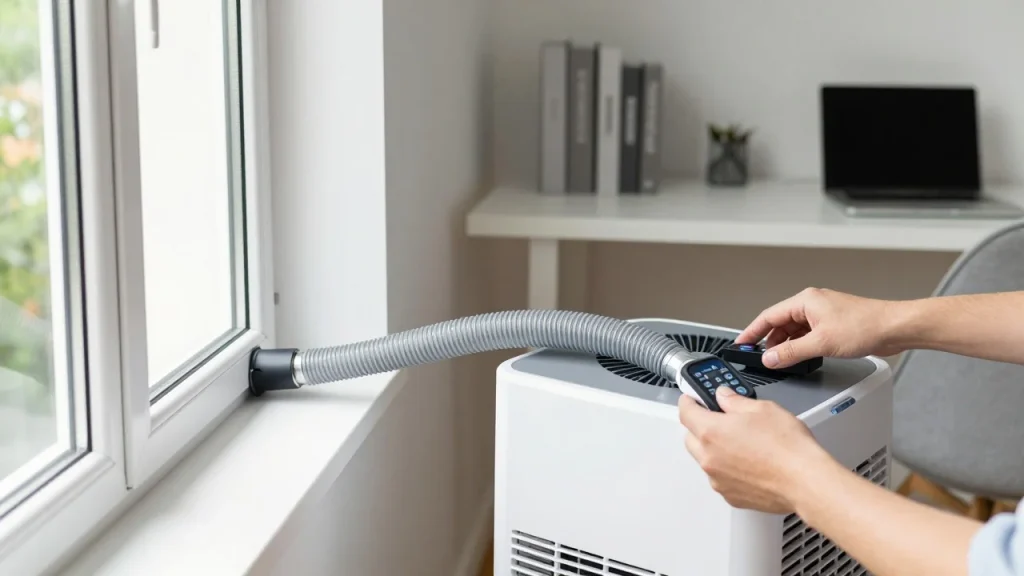
A portable AC removes heat from the room and sends that heat outside through an exhaust hose. If hot exhaust air leaks back through an open window, the machine has to work harder. A close-fitting window kit helps prevent that cycle.
This matters in UK homes because many windows open outward or have casement or tilt-and-turn designs. Check the supplied kit before ordering. A sliding-window panel may be useless on a side-hinged bedroom window.
Measure the opening first. Wrynia’s guide to measuring replacement windows can help you record the dimensions accurately before choosing a seal or panel.
Keep the exhaust route short and avoid sharp bends in the hose. A better seal and a sensible hose position reduce the amount of hot air returning to the room.
What Does It Cost to Run in the UK?
Ofgem’s electricity price-cap figure for direct-debit customers in England, Scotland, and Wales is 26.11p per kWh from 1 July to 30 September 2026. Your own tariff can differ, so use the rate shown on your bill when calculating your actual cost.
The calculation is simple:
Input power in kW × electricity price per kWh = approximate hourly cost.
| Rated input | Approximate cost at 26.11p/kWh |
|---|---|
| 800W | 21p per hour |
| 1,000W | 26p per hour |
| 1,200W | 31p per hour |
| 1,400W | 37p per hour |
Actual consumption can vary because the compressor cycles on and off. Independent UK tests also show meaningful differences between models.
A timer can help because you don’t always need the machine running throughout the night. Pre-cooling a bedroom before you go to sleep may be more economical than leaving the unit at maximum output for many hours.
Noise and “Portability” Need a Reality Check
Portable doesn’t mean lightweight. Some units weigh more than 20kg even though they have wheels. Moving one between rooms on the same floor can be realistic. Carrying it upstairs every evening is far less convenient.
Noise also varies by model and measurement method. Independent tests have recorded relatively low figures for some machines, while manufacturer-stated maximum figures for other models can reach roughly 60 to 65 dB. Compare figures measured under similar conditions before choosing a bedroom unit.
If you’re improving a work-from-home space, cooling is only one part of comfort. Wrynia’s guide to choosing a UK office chair for long working hours covers the seating side of the setup.
Portable AC vs Fan vs Air Cooler
These products are often grouped together by retailers, but they don’t cool in the same way. A fan moves air across your body. An evaporative cooler passes air through water. An AC system uses refrigeration to remove heat from the room and expel it outside.
| Product | Lowers room temperature? | Needs exhaust hose? | Energy use | Best suited to |
|---|---|---|---|---|
| Portable AC | Yes | Yes | Highest | Strong one-room cooling |
| Air cooler | Limited evaporative cooling | No | Lower | Personal cooling in suitable conditions |
| Fan | No | No | Lowest | Air movement and cheaper everyday comfort |
A fan remains the cheaper option when moving air is enough. Choose refrigeration-based cooling when you need the room temperature itself to fall. Also worth reading: Single Air Bed.
Features Worth Paying For
Focus on features that affect daily use rather than a long specification sheet. Useful options include timers, sleep settings, dehumidifying modes, washable filters, remote controls, and smart controls.
- A suitable window kit saves you from buying or improvising one later.
- A timer and thermostat give you more control over runtime.
- Sleep mode can help if the unit will be used in a bedroom.
- Dehumidifying mode adds value during muggy weather.
- Washable filters and easy drainage make routine maintenance simpler.
- App control is convenient, but it shouldn’t take priority over capacity, noise, or efficiency.
Check the energy label as well. UK energy-labelling rules cover air conditioners and comfort fans, so compare efficiency information between shortlisted models.
The Verdict: What Should You Buy?
Our recommendation is to choose by room size first, window setup second, and noise level third. Smart features should come later.
For a small bedroom or office, start by comparing models in roughly the 5,000 to 9,000 BTU range. For a room of around 20 to 30 m², 9,000 to 12,000 BTU models are more common starting points. Hot loft rooms, large windows, and strong afternoon sun may justify choosing a higher-capacity unit.
Portable cooling makes the most sense when you need relief in one room and can’t install a fixed system. It is less convincing if you want quiet, continuous cooling throughout several rooms.
Portable AC units are especially useful for renters and for cooling home offices or bedrooms where fixed installation isn’t practical.
Before ordering, measure your room and window, check the wattage, and confirm that the exhaust kit will fit. Then compare three suitable models using the same criteria. For more household guides, browse Wrynia’s Home Improvement section.
FAQ
Yes. Refrigeration-based portable units need to expel the heat they remove from the room. The usual setup sends that hot air outside through an exhaust hose and window kit.
It can be. One 9,000 BTU Meaco model is rated for spaces of 16 to 26 m², while a Pro Breeze 9,000 BTU unit is rated for rooms of up to 22 m². Check the specifications for the exact model because insulation, ceiling height, sunlight, and room layout can affect performance.
At the Ofgem reference rate of 26.11p per kWh for 1 July to 30 September 2026, a 1,000W unit costs about 26p for one hour at full rated input. A 1,400W unit would cost about 37p. Actual consumption can vary as the compressor cycles on and off.
No. An air cooler relies mainly on evaporation and airflow. Refrigeration-based AC removes heat from the room and sends it outside, so it can lower the room temperature much more effectively.
It can be if you have one room that becomes difficult to use or sleep in during hot weather. Portable units can be particularly useful for renters and households where fixed installation isn’t practical.