


A handheld fan is one of the simplest ways to get a personal breeze on a warm commute, at work, or while traveling. The useful models aren’t defined by size alone. Battery life, airflow, noise, charging, grip, and portability decide whether you’ll keep using one after the first hot week.
For most UK buyers, a rechargeable portable model with USB-C charging, at least three speeds, a comfortable grip, and a stable base is the most practical all-round choice. Pick a high-airflow model for crowded commutes, a folding model for desk use, or a neck model for hands-free cooling.
| What to check | Practical buying advice |
| Best all-round format | Rechargeable model with USB-C charging |
| Speed settings | Three or more gives useful control. |
| Battery | Match runtime to your commute, workday, or trip. |
| Noise | Lower settings matter in offices and on trains. |
| Portability | Check weight, shape, and bag space. |
| Desk use | Look for a stable base or folding handle. |
| Travel | Check battery and airline rules before flying. |
| Main priority | Comfortable airflow without excessive bulk |
Key Takeaways
- Buy for airflow, runtime, and comfort, not the number of advertised features.
- A folding rechargeable design works well for both travel and desk use.
- Higher speeds usually use battery power faster and create more noise.
- USB-C charging is convenient if you already travel with compatible cables.
- A wearable model makes more sense when you need both hands free.
- Small size is useful, but an awkward grip can make a compact device unpleasant to use.
Current independent UK tests look closely at wind speed, battery performance, noise, controls, and durability. That makes these more useful buying signals than a long feature list.
Which Handheld Fan Type Suits You Best?
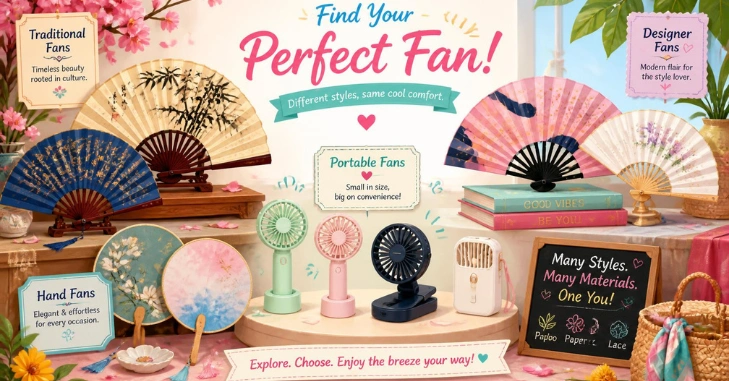
Handheld fan portable cooling devices now come in several forms. The right choice depends on where you expect to use yours most often.
| Type | Good fit for | Main advantage | Main drawback |
| Standard rechargeable | Everyday use and commuting | Balanced size and runtime | Must usually be held |
| Folding handheld-and-desk | Offices, bedrooms, and travel | Works in two positions | Hinge adds some bulk. |
| High-airflow model | Busy transport and hotter trips | Stronger personal breeze | Can be louder and heavier |
| Wearable neck model | Walking, events, and hands-free use | Leaves both hands free | More noticeable to wear |
| Misting model | Outdoor use in dry, hot conditions | Adds evaporative cooling | Extra parts and maintenance |
Standard Rechargeable
A straightforward rechargeable fan is a sensible option if you want something for trains, buses, queues, or lunch breaks. Simple controls also make it easier to change speeds without looking at the device.
Pros
- Easy to carry
- Simple controls
- Wide choice of sizes and prices
Cons
- Needs one hand during use
- Smaller models may produce gentler airflow
Folding Handheld-and-Desk Design
A folding model is useful if the device will move between your bag and your desk. The handle folds into a stand, so you can position it beside a laptop or on a bedside table.
This format is especially useful for hybrid workers. You get a personal cooling device for the journey and a compact desk unit once you arrive.
Pros
- Two useful operating positions
- Easy to place on a desk
- Good choice for travel
Cons
- Folding joints can add thickness
- Stability varies between designs
If you like to compare household devices by size, storage, and practical features, Wrynia’s heated clothes airer buying guide takes a similar feature-first approach.
High-Airflow Models
A more powerful portable fan may be better suited for crowded public transport or travel to warmer countries. These models often use a more powerful motor and offer a broader range of speeds.
The trade-off is usually weight, sound, or battery consumption. Maximum power can feel useful for short bursts, while a lower setting may make more sense during longer journeys.
Pros
- Stronger airflow at close range
- More control on models with several speeds
- Useful for short periods of intense heat
Cons
- Often heavier
- Higher settings can be noisier
- Maximum power can shorten runtime
Wearable Neck Models
A neck fan is worth considering if holding a device becomes inconvenient. It can work well while walking, attending an outdoor event, or doing tasks that require both hands.
Check the weight before buying. A model that feels fine for ten minutes may become irritating after an hour. The direction of the airflow also matters because designs position their vents differently.
Pros
- Hands-free cooling
- Useful while walking
- No need to keep gripping a handle
Cons
- Worn visibly around the neck
- Extra weight can become tiring
- Less flexible than pointing a handheld model directly
7 Features to Check Before Buying
1. Airflow and speed control
More speed settings don’t automatically mean better performance. What matters is whether the lowest level feels gentle and the higher levels provide enough airflow when the heat becomes uncomfortable. Look for at least three useful settings. That gives you quieter indoor cooling and stronger outdoor airflow.
2. Battery life at the speed you’ll use
Battery claims need context. A device may run far longer on its lowest setting than at maximum power. Current UK models show a wide spread in claimed and tested runtimes. Some run for a few hours, while certain models can continue far longer on low settings.
Think about your normal day rather than chasing the biggest battery figure. A two-hour commute needs a different setup from a festival, a long train journey, or a full day of sightseeing.
3. Charging connection
USB-C is convenient because many phones, tablets, and accessories now use the same connector. It can reduce the number of cables you need to pack.
Check whether the charging cable is included. Also confirm whether the device can operate while charging if that feature matters at your desk.
4. Noise
A powerful personal fan can become distracting in a quiet office, library, or bedroom. Noise also matters on public transport if the device sits close to your face. Independent testing shows that noise levels vary considerably between current products.
If you expect long periods of indoor use, prioritize acceptable sound at low or medium settings rather than maximum power.
5. Weight and grip
A mini fan should feel comfortable in your hand, not merely look compact in product photographs. Check the listed weight and handle dimensions before ordering.
A heavier device may be fine on a desk but tiring during a long queue. A slim model can also be awkward if the handle is too narrow or slippery.
6. Stable desk mode
A base or folding handle adds much more value if you work at a computer. It also means you don’t need to hold the device continuously. Check how the air can be angled once the unit is standing. A fixed position may send the breeze towards your chest rather than your face.
7. Build quality and controls
The main button should be easy to reach without changing your grip. Speed indicators are useful if the device offers several settings.
For regular travel, check whether the blades sit behind a firm protective grille. A lanyard can also help when you’re using the device outdoors or in crowded places.
Using Portable Cooling on UK Commutes and Holidays
A compact cooling device is especially useful because you can move it between places where fixed cooling isn’t available. That might mean a platform, a warm train carriage, an outdoor queue, or a hotel room.
For holiday planning and other travel ideas, browse Wrynia’s travel guides. If you’re packing for a hotter destination, the Dubai holidays guide also covers seasonal conditions and trip planning.
Battery-powered products deserve extra attention when flying. The UK Civil Aviation Authority advises passengers to pack lithium batteries safely and keep power banks and spare batteries in hand luggage. Check your airline’s current rules for your specific device before departure.
A Personal Breeze Isn’t a Complete Heat-Safety Plan
A portable device can make warm conditions feel more comfortable, but it shouldn’t be your only response to extreme heat. Drink enough fluids, avoid unnecessary exposure during the hottest part of the day and keep indoor spaces as cool as possible.
Current NHS hot-weather guidance recommends shade, cool drinks, light clothing, and steps to reduce heat inside the home. Heat exhaustion and heatstroke need proper attention rather than relying on airflow alone.
Our Verdict
If you want a one-hand-held fan for several situations, start with a rechargeable folding design. Look for USB-C charging, at least three speeds, a stable desk position and a weight you’re comfortable carrying. Choose a high-airflow version if cooling power matters more than pocket size. Pick a wearable design when hands-free use is your main need.
Don’t pay extra for features you’ll rarely use. A simple handheld fan with comfortable airflow, dependable controls, and suitable runtime can make more sense than a complicated premium model.
The easiest way to choose the right handheld fan is to picture one normal hot day. Consider where you’ll carry the device, how long you’ll run it, and where you’ll charge it. Those answers will narrow the choice faster than comparing feature counts.
Frequently Asked Questions
A rechargeable folding model is a practical choice for many UK users. It can provide personal cooling while travelling and then sit on a desk when you reach work or home. Prioritize adequate airflow, comfortable weight, and dependable battery life.
Runtime varies greatly by model and speed. Higher settings usually drain the battery faster. Current UK testing shows that some devices last only a few hours in demanding use, while selected models can run much longer at lower speeds.
Choose handheld if you want to aim the airflow exactly where you need it. Choose wearable cooling if you need both hands free while walking, working, or attending an outdoor event.
Battery rules depend on the device and airline. Check the battery type and capacity before traveling. The UK CAA advises passengers to keep power banks and spare lithium batteries in hand luggage rather than checked baggage.
Small personal models are designed to move air around one person at close range. They won’t replace a larger room unit when you need airflow across a wide space.
Yes, especially if your phone and other travel devices already use USB-C. Sharing one cable type can make charging easier at work or while traveling.