
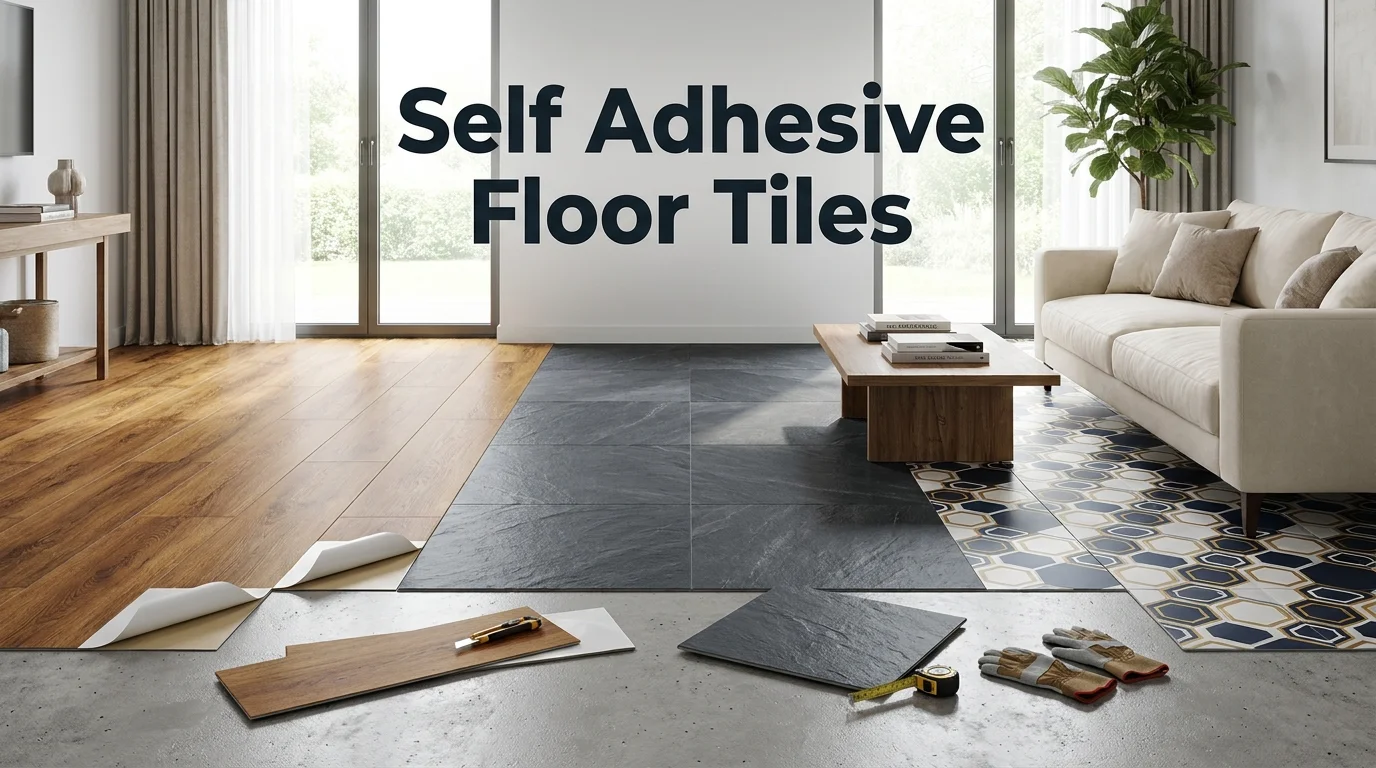
Self adhesive floor tiles can give a kitchen, bathroom, utility room or hallway a new look without traditional tile adhesive or grout. They suit DIY projects where cost, speed and easy cutting matter, but the surface underneath has to be suitable. Before buying, compare the price per square metre, floor rating, water resistance and installation instructions rather than choosing by pattern alone.
| Quick fact | What UK buyers should know |
|---|---|
| Typical material | Vinyl or PVC with a pre-applied adhesive backing |
| Current price examples | Around £14 to £22 per m² for several mainstream products checked in September 2026 |
| Installation | Peel backing, position the tile and press it onto a prepared surface |
| Suitable rooms | Kitchens, bathrooms, hallways and utility rooms when the specific product permits |
| Main requirement | A smooth, stable, clean and dry base |
| Main limitation | Compatibility with moisture, heating and existing flooring varies by product |
| DIY difficulty | Usually lower than ceramic or porcelain tiling |
| Best buying check | Read the manufacturer’s surface and room guidance before ordering |
For UK buyers, peel-and-stick vinyl can be a practical low-cost update when the base is smooth, stable, clean and dry. Current examples start around £14 per m², while mainstream ranges also sit near £18–£22 per m². Check each product’s wet-area, heat and subfloor rules before buying.
Key takeaways
| Question | Short answer |
|---|---|
| Are they cheap? | Many current products cost less per m² than a traditional tiled project once you factor in fitting materials. |
| Are they easy to fit? | Usually, but preparation matters more than the peeling and sticking itself. |
| Can they go in bathrooms? | Many can, although water-resistant does not automatically mean suitable for permanently wet areas. |
| Can they cover existing surfaces? | Some products can cover suitable hard finishes, but instructions vary by brand. |
| Are they renter-friendly? | Some are marketed as removable, but you shouldn’t assume removal will leave every surface unchanged. |
| Are they compatible with underfloor heating? | Sometimes. Check the product instructions, as guidance differs between ranges. |
Are Self Adhesive Floor Tiles Worth It in the UK?
They make the most sense when you want a fast cosmetic update and the existing base is already flat and sound. No wet adhesive needs mixing, and many products can be cut with a craft knife or similar basic tool. Retailers, including Homebase, market peel-and-stick products as accessible to DIY users with limited fitting experience.
Their main weakness is also simple: the adhesive depends on the surface below it. Dirt, movement, deep joints or uneven boards can affect how well the material sits and stays in place. A low purchase price will not compensate for poor preparation, so inspect the existing surface before choosing the finish.
| Flooring option | DIY fitting | Surface preparation | Water considerations | Long-term commitment |
|---|---|---|---|---|
| Peel-and-stick vinyl | Relatively simple | High importance | Product-specific | Lower |
| Sheet vinyl | Moderate | Smooth base preferred | Product-specific | Moderate |
| Click vinyl | Moderate | Stable base needed | Product-specific | Moderate |
| Ceramic or porcelain | More involved | Strong, prepared base | Suitable products work well in wet rooms | Higher |
Ceramic and porcelain remain useful alternatives where durability, wet-area performance or a permanent finish takes priority. Wrynia’s bathroom tiles guide explains the practical differences between ceramic and porcelain for UK bathrooms. It also covers floor suitability and wet-condition grip, which deserve extra attention in bathrooms.
What Do Peel-and-Stick Vinyl Tiles Cost in the UK?
Current prices vary because retailers sell different tile sizes, pack quantities and quality levels. B&M lists a grey stone-effect pack covering 1 m² at £14, while Bricoflor lists selected Gerflor ranges from £17.95 per m². Victorian Plumbing currently shows several FloorPops products at £21.54 per m².
Pack prices can make comparison harder, so calculate the cost for the whole room rather than comparing box prices. Allow for cuts, damaged pieces and future repairs when deciding how much material to order. Prices and stock change frequently, which means the figures below should be treated as a September 2026 snapshot.
| UK retailer | Example checked | Listed price | Availability signal |
|---|---|---|---|
| B&M | Grey stone-effect vinyl, 1 m² | £14 | Store availability varies |
| Bricoflor | Gerflor Prime | £17.95/m² sale price | Listed in stock |
| Bricoflor | Gerflor Senso Natural | £21.95/m² sale price | Listed for sale |
| Victorian Plumbing | Selected FloorPops designs | £21.54/m² | Several listed in stock |
| Dunelm | Selected peel-and-stick designs | About £17–£20 per product | Range available online |
Dunelm currently carries dozens of patterns, including wood, marble and geometric effects, so colour choice is not limited to plain finishes. Homebase also lists wood, concrete, floral and patterned alternatives across different pack sizes. These ranges show why comparing coverage per pack matters more than comparing the headline price alone.
Which Surfaces Can You Stick Them To?
A hard, smooth, stable surface gives the adhesive the strongest starting point. Existing ceramic or similar flooring may be suitable if it is secure and reasonably level, although deep grout joints can show through a thin covering. Victorian Plumbing advises filling grout lines before fitting certain peel-and-stick products over existing finishes.
The catch is that brands don’t give identical instructions. A D-C-Fix listing advises against fitting its product over uneven floorboards, floating floors, lino, carpet or radiant-heated floors. Other ranges permit selected existing surfaces or specific heating systems, so the instructions supplied with the exact product should take precedence over general advice.
| Existing surface or condition | Practical check before fitting |
|---|---|
| Smooth ceramic | Check stability and fill noticeable joints where required |
| Existing vinyl | Confirm that the chosen product permits installation over it |
| Timber or boards | Level movement and uneven joints before covering |
| Carpet | Do not treat it as a suitable bonding surface |
| Cracked or loose base | Repair the problem before installing a decorative finish |
| Underfloor heating | Confirm the exact system and temperature limits in the product specification |
Surface preparation is more than routine cleaning. Dust and grit can interfere with adhesion, while bumps or joints may show through thinner vinyl. UK DIY guidance also stresses levelling uneven timber bases before applying this type of covering.
Can You Use Peel-and-Stick Flooring in Kitchens and Bathrooms?
Many ranges are sold for kitchens and bathrooms because vinyl is easy to wipe and some products are water-resistant. Victorian Plumbing describes its self-adhesive vinyl as suitable for everyday splashes but advises against using it in areas that stay continuously wet, such as inside a shower enclosure. That distinction matters because water-resistant and waterproof are not interchangeable claims.
Bathroom safety also deserves attention before appearance. One d-c-fix listing states that its tiles are not slip resistant and recommends a mat in wet areas, which shows why buyers should check the individual product specification. If you are planning a larger kitchen update, Wrynia’s kitchen island planning guide can help you organise the room layout before committing to new finishes.
How to Fit Peel-and-Stick Vinyl Tiles
Good preparation affects the result more than fitting speed. Start by reading the supplied instructions because acceptable surfaces and room conditions differ between manufacturers. Then work methodically so pattern lines, joins and cut edges stay consistent.
- Check the product specification. Confirm that it is rated for floors, the intended room, and your existing surface.
- Inspect the base. Repair loose sections, noticeable cracks, deep joints, or areas that move underfoot.
- Clean and dry the surface. Remove dust, grit, grease and other residue that could weaken adhesion.
- Plan the layout. Dry-position a row before removing the backing paper so narrow edge cuts and pattern alignment don’t come as a surprise.
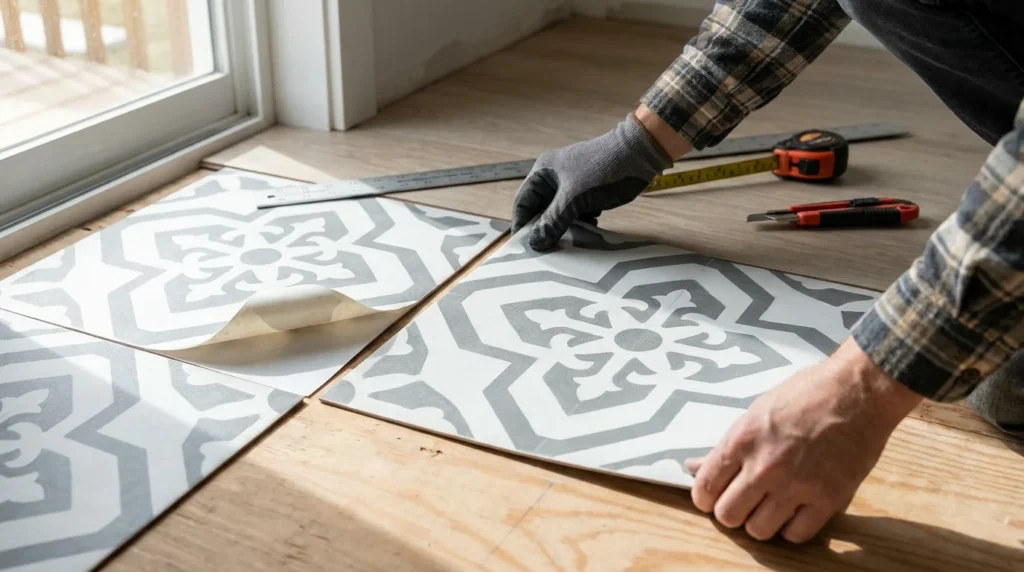
- Peel, position and press. Avoid touching the adhesive more than necessary, align each piece carefully and press it firmly into place.
- Cut edges carefully. Use the cutting method recommended by the manufacturer and make a template around awkward fittings where useful.
- Follow aftercare instructions. Respect any product-specific guidance on cleaning, heating and when the newly covered area can receive normal use.
Homebase advises installing onto a clean, dry surface and pressing the pieces down firmly after positioning. Product guidance also recommends checking design direction before sticking patterned material because mistakes become harder to correct once the adhesive has bonded. Taking a few minutes to dry-plan the first row can prevent a visible alignment problem across the room.
If the base needs major levelling, the job has moved beyond a simple decorative refresh. Covering movement or significant damage can hide the symptom without fixing the cause. Deal with the substrate first, then install the finish on a surface that meets the manufacturer’s requirements.
Common Problems, Cleaning and Removal
Lifting edges often point back to preparation, movement, contamination, or a surface that the adhesive was not designed to cover. Visible ridges can also appear when thin vinyl is laid over pronounced joints or uneven boards. These problems are easier to prevent before fitting than to correct across a completed room.
Cleaning should also follow the individual care instructions. Victorian Plumbing recommends warm soapy water or a gentle cleaner for its self-adhesive products and advises against steam mops because heat can soften adhesive. Avoid abrasive products unless the manufacturer specifically approves them.
Some ranges are marketed as removable or repositionable, which can appeal to renters. That does not guarantee damage-free removal from every painted, tiled or vinyl surface because adhesives and substrates vary. Test in an inconspicuous area where possible, and get any required landlord approval before making a rental-property alteration.
What Should You Check Before Buying?
Start with technical suitability, then choose the colour or pattern. A good-looking pack is poor value if it cannot be used with your subfloor, heating system or room conditions. Comparing specifications also prevents you from assuming that one brand’s installation rules apply to another.
| Buying check | Why it matters |
|---|---|
| Floor-rated use | Wall-only decorative products are not automatically suitable underfoot |
| Price per m² | Makes differently sized packs easier to compare |
| Pack coverage | Helps calculate how many packs the room needs |
| Water guidance | Separates splash resistance from constant wet-area use |
| Surface compatibility | Reduces the risk of weak adhesion or visible imperfections |
| Heating compatibility | Manufacturer guidance differs between products |
| Slip information | Particularly relevant in bathrooms and entrances |
| Cleaning instructions | Protects the adhesive and decorative surface |
| Batch or design consistency | Helps patterned areas look uniform |
| Spare material | Gives you matching pieces for later repairs |
A useful rule is to reject any option whose instructions are unclear about your room or existing floor. Then compare the remaining choices on cost, design and availability instead of trying to make an unsuitable product work. Wrynia’s broader Home Improvement section has more UK renovation and DIY planning guides for related projects.
The Verdict for UK Buyers
Peel-and-stick vinyl is a sensible option for a quick, budget-conscious refresh when the base is smooth, and the product is approved for the intended room. It is less convincing when the subfloor moves, the area stays wet, or the manufacturer rules out your heating or existing flooring. Good preparation and careful specification checks matter more than simply peeling off the backing.
Ready to buy? Measure the room, shortlist two or three floor-rated products and compare their current price per m², stock and technical instructions. Buy only after confirming surface, moisture, heating and cleaning requirements for the exact range you have chosen. Keeping one unopened spare pack can also make future matching repairs easier.
Frequently Asked Questions
How long do self-adhesive floor tiles last?
There is no single reliable lifespan for every brand because thickness, wear layer, adhesive, traffic and surface preparation all differ. Judge a correctly fitted domestic product against its stated usage class and warranty rather than a generic lifespan claim. Gerflor, for example, currently lists a three-year warranty for one Prime range, but that warranty should not be treated as the expected life of every product.
Can you put peel-and-stick vinyl over existing tiles?
Some products can be fitted over secure existing ceramic surfaces, but the base needs to be flat, clean and stable. Pronounced grout lines may need filling because thin vinyl can follow the shape beneath it. Always check the selected product’s instructions before covering an existing finish.
Are peel-and-stick tiles suitable for bathrooms?
Many products are sold for bathroom use and can handle normal splashes, but that doesn’t mean every range is suitable for continuously wet zones. Check water resistance, floor rating, and slip information before installing anything underfoot. Keep products that are only splash-resistant out of areas the manufacturer excludes.
Can I use them with underfloor heating?
Compatibility depends on the specific product and the heating system. Gerflor lists selected self-adhesive vinyl as compatible with water-based underfloor heating, while another d-c-fix listing advises against radiant-heated floors. Read the technical sheet for the exact range instead of applying a general rule.