

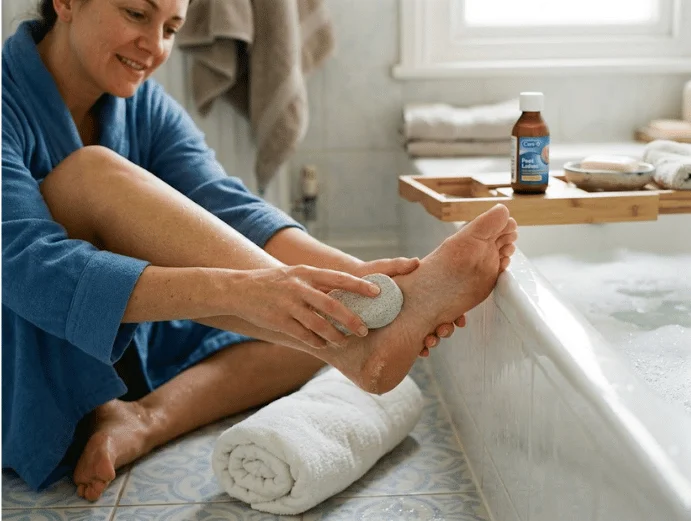
A pumice stone is one of the simplest tools for dealing with rough, thick, or callused skin, particularly on the heels and soles of the feet. Its naturally abrasive surface can gradually smooth away excess dead skin without the blades or cutting tools that should not be used for home treatment. Used gently and consistently, it can form a useful part of a straightforward foot-care routine.
However, more scrubbing does not necessarily produce better results. Applying too much pressure, using one on broken or delicate skin, or failing to keep the stone clean can lead to soreness and skin damage. People with diabetes, poor circulation, or certain other health conditions also need additional caution before treating corns or calluses themselves.
Quick answer: A pumice stone is a lightweight, porous volcanic rock used as a gentle abrasive to remove hard, dead skin, especially from heels and callused feet. For safe use, soften the skin, wet the stone, rub lightly rather than aggressively, rinse, moisturise afterwards, and let the stone dry fully between uses.
What Is a Pumice Stone?
Pumice is a highly porous volcanic rock created when gas-filled molten material cools rapidly during volcanic activity. The trapped bubbles leave numerous small cavities in the hardened rock, producing its familiar lightweight and rough texture. The U.S. Geological Survey describes pumice as a low-density, highly porous volcanic rock formed by rapidly cooled, air-pocketed lava.
Those pores also make it useful as a physical exfoliant. Instead of chemically dissolving dead skin, the rough surface creates gentle friction that helps wear down the thickened outer layers of skin. Pumice is also used industrially as an abrasive, but the shaped stones sold for personal care are intended for controlled use on suitable areas of the body.
| Pumice basics | What to know |
|---|---|
| Material | Naturally occurring porous volcanic rock |
| Main personal-care use | Smoothing hard, rough, and callused skin |
| Best-known area of use | Heels, soles and other thick-skinned areas of the feet |
| How it works | Mechanical exfoliation through gentle friction |
| Ideal pressure | Light and controlled |
| Aftercare | Rinse the skin, moisturise and dry the stone completely |
| Areas to avoid | Broken, inflamed, infected or highly sensitive skin |
What Is Pumice Used For?
The most common use for one is reducing accumulated hard skin on the feet. Corns and calluses develop where repeated pressure or friction causes the skin to thicken, and the NHS includes regular use of a stone or foot file among the self-care measures that can help remove hard skin. Moisturising and wearing comfortable footwear are also important because filing the skin does not correct the pressure or rubbing that caused it.
The stone may be particularly useful around rough heels and thicker areas of the sole. It can also be used carefully on some callused areas of the hands, although the same rule applies: remove only excess hard skin and never continue until the area becomes sore. It is an exfoliating tool rather than a treatment for every lump, lesion or skin condition.
Pumice is therefore most useful when the problem is clearly superficial hard skin. Persistent pain, bleeding, discharge, unusual changes in colour, or skin that repeatedly splits deserve professional assessment rather than harder scrubbing. The NHS recommends seeking medical advice when a corn or callus bleeds, produces discharge, fails to improve with home treatment, or occurs alongside conditions that can make foot problems more serious. NHS guidance on corns and calluses says to see a GP if there is no improvement after three weeks of treating one yourself.
Pumice Benefits for Feet
The biggest advantage is controlled mechanical exfoliation. A few gentle passes can gradually reduce the rough surface caused by accumulated dead skin, leaving the heel or sole feeling smoother and more comfortable. Regular light maintenance is generally preferable to allowing very thick skin to build up and then trying to remove too much at once.
It is also inexpensive, reusable, and does not require an electrical device or complicated routine. Natural stones can withstand repeated use when they remain intact and are properly cleaned and dried. For people who prefer simple grooming tools, that makes pumice an accessible addition to an at-home foot-care kit.
The stone works best as one part of a broader routine rather than as a stand-alone solution. Moisturiser helps keep dry skin supple, while properly fitting shoes can reduce the friction and pressure that contribute to hard skin in the first place. NHS guidance similarly combines gentle filing with moisturising and appropriate footwear rather than relying on abrasion alone.
How to Use a Pumice Stone Safely
Good technique matters because pumice can remove healthy skin as well as excess dead skin when used aggressively. Some clinical foot-care guidance recommends softening a corn or callus with warm water before gently reducing the thickened skin, while other NHS podiatry advice describes light filing on dry skin. Whichever method is appropriate for you, applying gentle pressure and stopping before the skin becomes tender are more important than trying to remove everything in a single session.
1. Check the skin first
Look closely at the area you plan to treat before starting. Do not rub across cuts, bleeding cracks, blisters, rashes, inflamed skin, or areas that appear infected. If you cannot confidently identify the problem as ordinary hard skin, it is safer to ask a pharmacist, GP or podiatrist for advice.
2. Soften the hard skin
Warm water can make thickened skin easier to work with, and NHS corn-and-callus guidance advises soaking affected areas to soften them. Keep the water comfortably warm rather than very hot, especially if sensation in your feet is reduced. You do not need to leave your feet soaking for a prolonged period to make the skin workable.
3. Wet the stone
If you are using a wet-filing method, wet the stone before bringing it into contact with the skin. A damp stone generally moves more smoothly than a completely dry one, making it easier to control the amount of friction. Hold it securely so you do not compensate for a poor grip by pressing harder.
4. Rub gently over the hard skin
Move the stone lightly across the thickened area rather than grinding it forcefully into one spot. Small circular or controlled back-and-forth movements are commonly used, but pressure should remain gentle throughout. Stop as soon as the area begins feeling tender, sore, or unusually sensitive.
5. Rinse and inspect
Rinse away loosened skin so you can see how much has actually been removed. The goal is a gradual reduction in roughness, not perfectly smooth skin after one session. If the area still feels thick, leave further work until another day instead of continuing until the skin becomes irritated.
6. Apply moisturiser
After drying the feet carefully, apply an appropriate moisturising foot cream to dry areas. Regular moisturising can help keep the skin more supple and is recommended alongside filing in UK foot-care guidance. Avoid leaving excess cream between the toes, where trapped moisture can cause other problems.
7. Clean and dry the stone
Rinse the stone thoroughly to remove skin debris after every use. Leave it somewhere well-ventilated until it is completely dry rather than storing it wet in a sealed shower corner or container. Northern Ireland’s nidirect guidance specifically advises allowing the stone to dry completely between uses to prevent it from harbouring bacteria.
How Often Should You Use One?
There is no benefit in aggressively exfoliating the same area every day simply to keep it perfectly smooth. Guy’s and St Thomas’ NHS Foundation Trust advises gently filing hard skin with a foot file or stone once or twice each week in its general foot-care guidance. This is a sensible starting point for many people, provided the skin is healthy and does not become sore.
Frequency should ultimately depend on how your skin responds. Someone with a small amount of dry heel skin may need the stone less often, while someone prone to calluses may benefit from regular light maintenance alongside moisturising and better-fitting footwear. If the skin continues to thicken rapidly despite self-care, identifying the underlying source of pressure is more useful than increasing the frequency of filing.
Can You Use Pumice on Your Face?
Pumice is usually too abrasive for facial skin. The skin on the heels is adapted to much greater pressure and friction than the skin on the cheeks, forehead, or around the eyes, so a tool designed for hard foot skin can easily cause unnecessary irritation elsewhere. Medically reviewed guidance from WebMD likewise notes that pumice works best for tough skin such as the feet and may be too harsh for more sensitive areas.
For facial exfoliation, products designed specifically for the face give you much more control over strength and frequency. The thin skin around the eyes still needs gentler care, which is why eye creams for the delicate under-eye area are formulated quite differently from hard-skin tools. Wrynia’s guide to best Korean skincare also covers facial routines built around gentler exfoliation, hydration and moisturising rather than using a hard-skin tool on delicate facial areas. Facial skin and thick foot calluses should therefore be treated as different skincare problems.
Who Should Avoid Pumice Without Medical Advice?

The main concern is that small injuries may be harder to notice or heal in some people. The NHS advises people with diabetes, circulation problems, or a weakened immune system to seek medical help when dealing with corns or calluses, as foot problems can become more serious. People with reduced sensation in their feet should also be particularly cautious, as they may not feel excessive rubbing that has damaged the skin.
You should also avoid using the stone over infected, bleeding or broken skin. Redness, swelling, unusual warmth, increasing pain or discharge can indicate that an area needs assessment rather than exfoliation. Guy’s and St Thomas’ list swelling, heat, pain, discharge, and redness among the signs that should prompt contact with healthcare services.
If you are unsure whether your hard skin is safe to manage yourself, a pharmacist or podiatrist can help. That is especially useful when the problem is painful, repeatedly returns in the same spot, sits over a prominent joint, or appears different from a straightforward callus. Treating the underlying pressure or footwear problem may yield better long-term results than repeatedly filing the surface.
Pumice vs Foot File: Which Is Better?
Neither tool is automatically better for everyone. Natural pumice has an irregular, porous surface and feels relatively forgiving when used with light pressure, while manufactured foot files come in different levels of coarseness and can remove hard skin efficiently. Your grip, skin thickness, and ability to control pressure matter as much as the type of tool.
A natural stone may appeal if you want a simple, compact tool with no moving parts. A handled foot file may make it easier to reach the heel, particularly for people who find a small stone difficult to hold. Whichever option you choose, the NHS treats both as tools for gently reducing hard skin rather than instruments for removing a callus down to normal skin in a single session.
Natural Pumice vs Synthetic Pumice-Style Blocks
Natural pumice comes directly from volcanic rock, so pore size, shape, colour and texture can vary from one stone to another. That variation means two natural stones may feel noticeably different even when sold for the same purpose. The rough, vesicular structure results from gases trapped as volcanic material rapidly cools.
Shops also sell manufactured pumice-style blocks and other abrasive foot-care tools with a more uniform texture. These may be shaped for an easier grip or made with different abrasive surfaces, but a manufactured block should not automatically be assumed to have the same composition as natural volcanic pumice. Check the product description if buying genuine natural stone is important to you.
What to Look for When Buying One in the UK
You do not need the most complicated product on the shelf. The best option is one you can hold securely and use with light, controlled pressure, so size and shape should suit your hand. A hanging cord can also be useful, as the stone needs sufficient airflow to dry thoroughly after use.
Consider the texture before buying as well. Very coarse stones can feel unnecessarily aggressive on modest areas of hard skin, while a very smooth stone may take longer on a thick heel callus. Beginners are generally better served by choosing controllability over maximum abrasiveness.
Natural stones are widely available from UK pharmacies, beauty retailers and online shops, along with handled files and combination tools. Instead of choosing solely on advertising claims, look for clear material information, a practical shape and straightforward cleaning instructions. A low-cost stone that can be used gently and kept dry is more useful than an elaborate tool that encourages over-filing.
Common Pumice Mistakes to Avoid
Scrubbing until the skin feels sore
Tenderness is a sign to stop, not a signal that the stone is finally working. The goal is to reduce excess hard skin gradually while leaving healthy skin intact. Continuing after discomfort begins increases the risk of irritation or skin breakage.
Trying to remove a corn with a blade afterwards
Do not follow filing by cutting, shaving, or slicing the remaining hard skin yourself. NHS advice specifically warns against trying to cut off corns or calluses at home. A painful or persistent corn can instead be assessed by a podiatrist, who can determine why the pressure is developing.
Ignoring footwear
The stone treats the surface effect of friction and pressure but does not stop those forces from returning. Tight, narrow or poorly fitting shoes can therefore undo the benefits of your foot-care routine. Comfortable footwear, cushioning where appropriate, and sufficient room around the toes are important for preventing recurrent hard skin.
Leaving the stone permanently wet
A stone sitting damp in a shower is not being stored particularly well. Rinsing it and allowing it to dry completely between uses is a simple hygiene measure recommended in UK foot-care advice. Replace the stone when it becomes difficult to clean, begins to break apart, or develops an unpleasant condition that cleaning and drying do not resolve.
The Bottom Line
A pumice stone can be a useful, inexpensive tool for gradually smoothing hard skin on healthy feet when it is used gently. The most effective routine combines light exfoliation with regular moisturising, clean and dry equipment, and footwear that reduces repeated pressure. Trying to achieve perfectly smooth skin in a single session is unnecessary and can cause more harm than good.
Pay particular attention to changes in the skin rather than simply following a fixed routine. Stop if an area becomes painful, raw, or starts bleeding, and seek advice if hard skin is persistent, unusual, or accompanied by signs of infection. Anyone with diabetes, poor circulation, reduced sensation, or another condition that increases foot-care risk should get professional guidance before attempting self-treatment.
For most other users, moderation is the key to getting value from it. A short session once or twice a week may be enough to keep rough areas manageable, especially when followed by suitable moisturiser. Consistent, gentle care is far more useful than aggressive filing.
Frequently Asked Questions
No, because it removes some of the existing thickened surface rather than eliminating the cause of the problem. Callus can return when pressure and friction continue in the same area. Better-fitting footwear, moisturising and addressing repeated pressure are therefore important for longer-lasting improvement.
Guidance varies according to the type of foot-care routine and the condition being treated. Some NHS resources describe filing dry skin, while corn-and-callus guidance may recommend softening thickened skin in warm water before gently filing it. The safest principle is to follow reliable guidance for your situation, use light pressure, and stop before the skin becomes tender.
It may help reduce surrounding hard skin when the heel is dry and intact, but it should not be rubbed over an open, bleeding, or painful crack. Moisturising is also important because cracked heels are commonly associated with dry, thickened skin. Deep, painful, inflamed, or repeatedly bleeding cracks are better assessed by a healthcare professional.
Sharing a personal exfoliating tool is best avoided. A stone comes into direct contact with skin and can retain skin debris within its porous surface, thereby making personal use more hygienic. Each person having their own stone also makes cleaning, drying, and replacement easier to manage.
There is no universal replacement date because durability varies with the stone and its use. Replace it if it cracks badly, crumbles, becomes excessively smooth, or can no longer be cleaned and dried satisfactorily. Regular inspection is more useful than keeping a damaged stone simply because it has not reached a particular age.
Do not assume routine callus treatment is safe when you have diabetes. The NHS advises people with diabetes to seek medical advice about corns and calluses, as relatively minor foot problems can become more serious. A GP, diabetes foot-care service or podiatrist can tell you which method is appropriate for your individual feet.